On this page
An automatic fish feeder can help deliver a consistent routine when feeding times do not match the household’s schedule. It is worth considering when the food dispenses reliably, the mounting fits and someone still checks the aquarium. It is a poor purchase if it cannot handle the food the fish eat or is expected to replace every form of vacation care.
This comparison uses the manufacturer’s current $39.99 price for Aquarium Co-Op’s feeder. The pictured device is an older Aqua One unit and is illustrative, not the product being priced. The budget arithmetic below makes no claim that a timer guarantees portion accuracy or that any tank can be left unattended for a fixed number of days.
Key figures
- $39.99 One Aquarium Co-Op automatic feeder
- $79.98 Two Aquarium Co-Op automatic feeders
- $159.96 Four Aquarium Co-Op automatic feeders
The $39.99 purchase automates one task
The current Co-Op feeder is a programmable dry-food dispenser with a rechargeable battery. The page lists up to four scheduled feedings daily, a manual-feed button and a one-year warranty. Those features do not include a person inspecting fish, maintaining water quality or responding to a power failure.
| Number of feeders | Published unit price | Purchase arithmetic before extras |
|---|---|---|
| One | $39.99 | $39.99 |
| Two | $39.99 | $79.98 |
| Three | $39.99 | $119.97 |
| Four | $39.99 | $159.96 |
Source note: Aquarium Co-Op’s own Auto Feeder listing, checked October 2026. Multiples are calculated from the unit price; no bulk discount, tax or shipping assumption is included.
- One feeder$39.99
- Two feeders$79.98
- Three feeders$119.97
- Four feeders$159.96
Source note: Aquarium Co-Op's own Auto Feeder listing, checked October 2026. Multiples are calculated from the unit price; no bulk discount, tax or shipping assumption is included.
Several aquariums may need separate devices rather than one dispenser shared between tanks. Include that count before comparing the purchase with the household’s existing routine. A device used for breeding or a specialized diet can have a different purpose from one used occasionally while traveling.
Do not add a subscription unless the chosen product charges one. This model’s described schedule is local to the device; a phone app is not necessary for every automatic feeder. A camera, controller or remote monitoring system would be a separate shopping decision.
The aquarium care budget keeps equipment purchases apart from food. Automating dispensing does not reduce the amount of nutrition the fish require, so the purchase should not be credited with an invented food saving.
Capacity depends on the food and tested output
Co-Op describes an approximately 200 mL hopper. Food volume cannot be converted to grams without the density of that food, and the hopper’s nominal capacity does not establish the number of days between refills. Large pellets, fine food and flakes can behave differently at the opening.
Measure dispensed portions outside the aquarium before relying on the schedule. Use the food that will remain in the hopper, the planned fill level and the setting that will be used. Observe several cycles rather than concluding that one successful manual press proves every timed cycle will match it.
For a hypothetical capacity calculation, suppose a hopper holds 60 grams of a particular dry food and measured dispensing totals 2 grams per day. The quotient is 30 days. If the measured total is 3 grams, it is 20 days. These are assumed measured inputs to illustrate refill planning, not feeding amounts for any fish or proof that food remains usable throughout that period.
Humidity, clumping and changes in fill level can affect dispensing. A correct programmed time does not help if the food fails to drop into the water or lands on the lid. Check the outlet location and repeat the check after refilling or moving the device.
Mounting clearance is part of the purchase decision
The Co-Op listing describes a clamp for rims under about 0.9 inches and an adhesive mounting option on a flat surface. It also gives the device’s dimensions: six inches long, 2.75 inches wide and about three inches above the aquarium rim. Check the physical opening, cover and nearby equipment before buying.
A wide center brace, a thick rim or a hood can change which arrangement works. A feeder mounted loosely near water can fall in; the maker warns against submersion. Do not turn an incompatible fit into an improvised installation with uncertain stability.
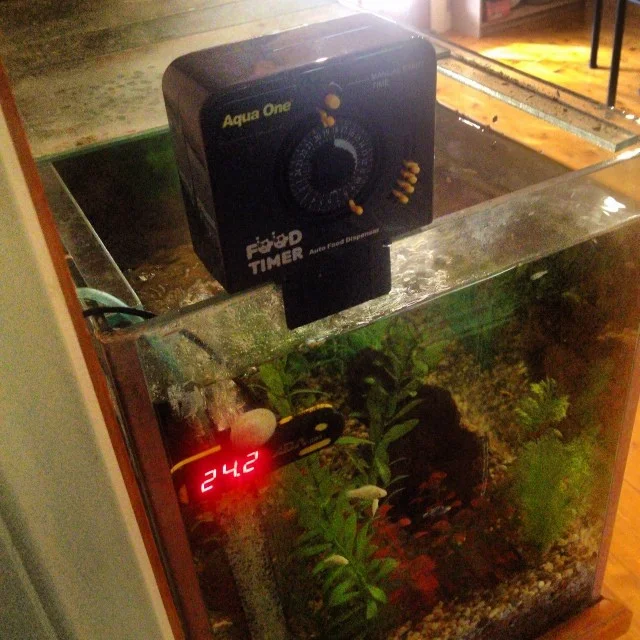
Make sure a caretaker can refill the hopper, charge the unit and see the settings without dismantling the tank cover. Label which device serves which aquarium if several feeders are used. A simple documented setup is easier to maintain than a collection of similar devices with unexplained schedules.
Keep food and equipment handling hygienic. The aquarium germs guide explains why hands should be washed after work around tank water and supplies; automatic dispensing does not remove those maintenance tasks.
Battery duration is not unattended-care duration
Co-Op describes roughly three hours to charge through USB-C and three to six months of battery operation depending on daily use. That battery estimate does not set a safe vacation length. Water, food condition, temperature, equipment reliability and fish health need their own observation plan.
Charge and test the feeder before a trip, then verify the programmed routine after any restart. Check whether a power interruption or low battery changes the settings. Leave the manual and a way to feed safely if the unit fails, with the person responsible for the tank identified.
CDC fish guidance advises checking fish daily for illness and discussing concerns with a veterinarian experienced in fish medicine. A long battery life does not perform that observation. The overfeeding guide explains why extra food should not be loaded into the tank to compensate for uncertainty about a trip.
The payback is usually convenience rather than fewer care visits
For a time-only illustration, assume setting and cleaning the feeder takes 20 minutes initially and it avoids a hypothetical three minutes of manual dispensing daily. Over 30 days, gross time avoided is 90 minutes; subtracting setup leaves 70 minutes before refills and checks. Those inputs are household assumptions, not timed performance tests.
Whether that time matters depends on the routine. A household may value a feeding time that would otherwise be missed more than the minutes saved. Another household that enjoys feeding and already has a reliable schedule may gain little from the purchase.
Do not calculate vacation savings by subtracting all sitter visits. A visit may include observation, equipment checks and water care in addition to feeding. If a hypothetical $20 visit still has to happen, buying a feeder avoids none of that $20 merely because food is now automatic.
Set food and feeding frequency for the species and life stage with aquatic-care guidance, and arrange veterinary assessment for sick fish. Test the device before depending on it, and keep a person responsible for observation and failure response.
The professional maintenance comparison distinguishes periodic maintenance from daily care. Keep those services separate when pricing a trip. Automation can complement a caretaker’s work without making the caretaker unnecessary.
Retain the receipt, instructions and tested settings. Recheck output after changing food, hopper position or the dispensing opening. A sound buying decision is based on fit and reliable output in the household’s routine, not on the maximum advertised feeding count or an assumed promise of worry-free travel.
Questions people ask
How much does an automatic fish feeder cost?
The Co-Op model checked here lists at $39.99 before extras. Other devices can have different capacity, mounting and control requirements; this is one manufacturer's price, not a national average.
Does a 200 mL hopper tell me how many days it lasts?
No. Food density and measured daily output determine refill intervals. Check the food and settings instead of converting the hopper volume into a universal number of days.
Can a feeder replace a fish sitter?
It can replace dispensing at a scheduled time, but it cannot observe fish, inspect equipment, maintain water or respond to a failure. Any reduction in care visits must follow those remaining responsibilities.
Should all four daily slots be used?
No. Four is a programming limit, not a feeding prescription. Frequency and portions should match the species, life stage and care plan, with output tested before the schedule is relied on.
Where these figures come from
- Auto Feeder: Current Price and Specifications Aquarium Co-Op · aquariumcoop.com
- Feeding and Aquarium Questions Aqueon · aqueon.com
- Fish: Monitoring Health and Care Centers for Disease Control and Prevention · cdc.gov
Figures last checked October 2026.