On this page
A canister filter can put a larger media chamber below or beside an aquarium, while a hang-on model keeps equipment at the rim. Neither arrangement is automatically the cheapest over its life. The pump’s power, replacement parts, cleaning access and fit can matter more than a modest difference at checkout.
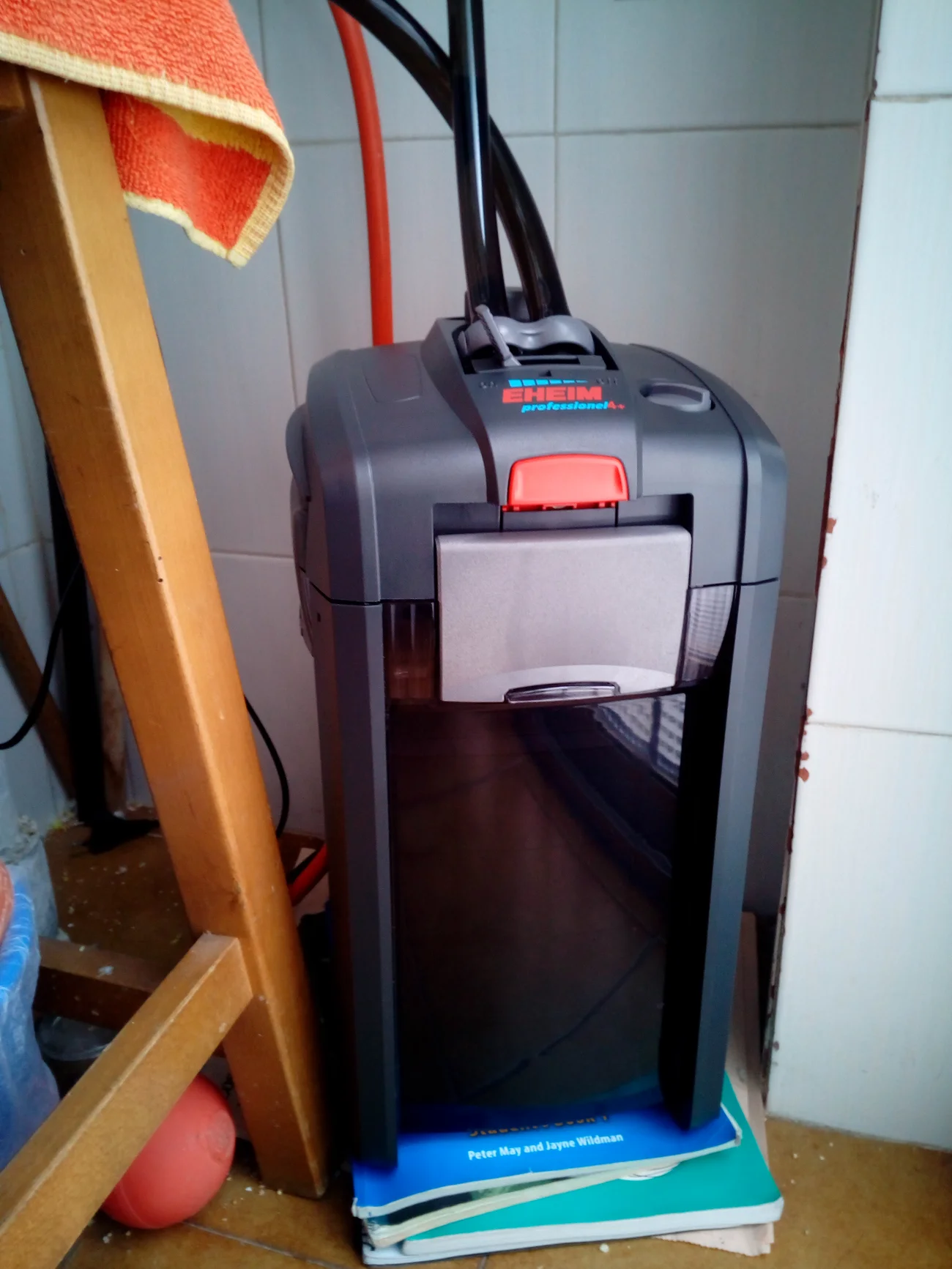
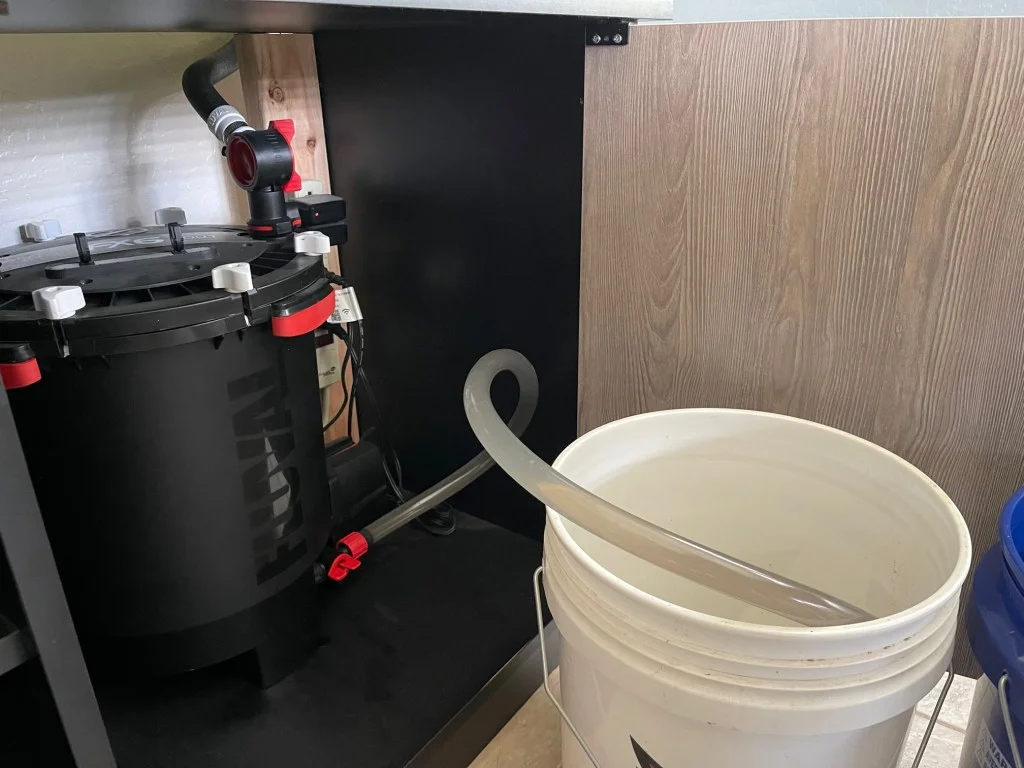
The prices here come from the manufacturer’s own U.S. store, checked in October 2026. They give a starting point for comparing two arrangements, not a national average or a claim that every aquarium in a gallon range can use the same filter. The Eheim canister pictured on the cover and the Fluval in the interior image illustrate the hardware; their purchase prices are not the Hygger prices below.
Key figures
- $25.99 Hygger HG108 5 W hang-on filter
- $37.99 Hygger HG108 8 W hang-on filter
- $99.99 Hygger canister starting price, unavailable when checked
Hang-on models span $25.99 to $37.99 in this range
Hygger calls its HG108 a hang-on-back canister filter. That name describes a sealed chamber attached at the tank, rather than the separate below-tank canister used in the next comparison. Read the installation arrangement before assuming that the word canister means cabinet-mounted equipment.
| HG108 version | Maker’s tank-size label | Listed price | Annual energy at continuous rated power |
|---|---|---|---|
| 5 W | Under 10 gallons | $25.99 | 43.80 kWh |
| 6 W | 10–20 gallons | $29.99 | 52.56 kWh |
| 7 W | 20–40 gallons | $33.99 | 61.32 kWh |
| 8 W | 40–60 gallons | $37.99 | 70.08 kWh |
Source note: Hygger HG108 product page and current variant data. All four were available when checked. Energy is calculated as rated watts × 24 hours × 365 days ÷ 1,000; it is not a metered result.
- 5 W$25.99
- 6 W$29.99
- 7 W$33.99
- 8 W$37.99
Source note: Hygger HG108 product page and current variant data. All four were available when checked. Energy is calculated as rated watts × 24 hours × 365 days ÷ 1,000; it is not a metered result.
The largest version costs $12 more than the smallest, but they are labeled for different aquariums. That $12 is not a saving obtained by putting an undersized filter on a larger tank. Stocking, debris, media capacity and the animals’ tolerance for current also affect the choice.
The pump-flow figures on product pages describe water movement under the maker’s test conditions. They do not prove that every gallon has passed through the media equally, or that ammonia is controlled. Avoid turning a headline flow rate into a guarantee about fish capacity. The aquarium cycling guide explains why water testing and an established biological filter matter independently of purchase price.
A separate canister costs more and occupies service space
Hygger’s Intelligent Canister catalog lists a non-UV 800L version at $99.99, UV-800L at $116.99, UV-1200L at $129.99, UV-1800L at $158.99 and UV-2200L at $168.99. All were out of stock in the current variant data. These are listed reference prices, not offers that can be delivered promptly to replace a failed pump.
The two 800L labels differ by $17, but do not compare either automatically with the $25.99 hang-on model. The specifications, mounting and capacity differ. A larger chamber or an added UV lamp is a feature to evaluate, not evidence that a tank requires the dearer option. The manufacturer’s canister range includes quick-disconnect hoses and removable baskets, which change the cleaning arrangement.
Allow room to release those hoses, open the lid and lift the baskets without dragging the tank or forcing connections. A cabinet that physically contains a filter can still leave too little space to service it. Ask whether the proposed installation includes hoses and media, and whether spare seals, impellers and model-matched fittings can be obtained.
The aquarium stand guide covers the separate question of supporting the full tank. Space for a canister under a stand does not establish the stand’s load rating, and a filter should not become a structural support for aquarium furniture.
Electricity can narrow a purchase-price advantage
At a hypothetical $0.20/kWh, the four HG108 rated-power calculations cost $8.76, $10.51, $12.26 and $14.02 per year. The difference between 5 and 8 W is about $5.26 a year. Over five years, that energy difference would total $26.28 if both drew their rating continuously and the rate stayed unchanged.
For a separate comparison, suppose a candidate canister draws 18 W continuously. That assumption produces 157.68 kWh and $31.54 a year at the same rate. Against 5 W, the added annual energy is 113.88 kWh, or $22.78. This is a worksheet scenario, not a measured Hygger variant or a reason to select a smaller filter than the aquarium requires.
Compare equally adequate options, then use their own published power or a safe measurement. A variable-speed setting may draw less than the maximum, so the largest printed wattage can overstate everyday consumption. The aquarium electricity budget includes the lights and heater that should not be attributed to the filter alone.
Replacement media belongs on its own budget line
A filter sold with media does not necessarily have a monthly cartridge bill. Find which components are washed, which are replaced when worn, and which chemical media have a manufacturer-stated service interval. Multiplying every item in the chamber by twelve can invent a recurring expense that the instructions never require.
For an explicitly hypothetical comparison, assume one arrangement uses a $6 replacement cartridge every month and another uses $20 of replacement media over a year. Their annual cash costs would be $72 and $20, a $52 difference. A $100 purchase premium would take about 1.9 years to recover from that difference alone, before electricity and repairs. Change the cartridge interval to every two months and the difference falls to $16 a year, making the same premium take 6.25 years.
These figures are not product prices or maintenance instructions. They show why the stated interval matters. Get the part number and replacement schedule before claiming a canister pays for itself. University of Florida guidance explains that the organisms in a biological filter require oxygen and that establishing a new biofilter can take six to eight weeks. Replacing an entire working biological system to save a small cartridge bill can create a much larger care problem.
If the old filter has failed or the fish are behaving abnormally, get an aquatic-care professional’s help with the transition and water results. A more powerful new pump does not instantly replace the biological activity of mature media.
Fit and repair access decide the final comparison
For the HG108, the maker specifies glass up to 0.7 inch thick and warns that plastic trim may obstruct the clamp. Measure the total rim, the lid opening and the clearance behind the aquarium. A glass-only measurement can pass while the assembled rim still fails.
Ask for the price with all required parts rather than comparing a working kit with a bare filter body. In a hypothetical checkout, a $33.99 filter plus $12 of additional fittings and $8 shipping totals $53.99 before tax. The $20 of added charges is larger than the $12 spread between the endpoint models. Confirm which charges exist for the chosen seller; do not add them to a manufacturer order that includes them already.
The cheaper adequate arrangement is the one that can be installed, maintained and repaired in the available space. Keep the model number, instructions and parts record with the aquarium budget. Treat filter replacement as a condition-based purchase, rather than assuming every pump needs replacing when a warranty expires.
Questions people ask
Is a canister always more expensive than a hang-on filter?
Not every product uses the names the same way. Hygger's rim-mounted HG108 lists $25.99–$37.99, while its separate Intelligent Canister lists $99.99–$168.99 and was unavailable. Compare capacity and installation, not the word canister alone.
How much does a 5 W aquarium filter cost to run?
Continuous rated-power operation uses 43.8 kWh per year. At an assumed $0.20/kWh, that is $8.76; use the household electricity rate and measured draw for a closer estimate.
Does every filter need a new cartridge each month?
No. Follow the model's instructions for mechanical, chemical and biological media. A monthly cartridge cost should be included only when the parts and interval support it.
Can a new filter make an aquarium safe immediately?
A new pump and chamber do not instantly establish a biofilter. Water testing and a care plan for preserving or establishing biological filtration remain separate from equipment purchase.
Where these figures come from
- HG108 Hang-on-back Canister Filter: Prices and Fit Hygger · hygger-online.com
- Intelligent Canister Filter: Current Variants Hygger · hygger-online.com
- Ammonia in Aquatic Systems University of Florida IFAS Extension · ask.ifas.ufl.edu
Figures last checked October 2026.