On this page
An aquarium lighting upgrade has a purchase price, an electricity cost and a fit requirement. A brighter fixture that leaves a strip of plants shaded may be less helpful than a lower-priced model that covers the tank well. A fixture advertised by gallon size can also be the wrong length for a tank with an unusual footprint.
Use the aquarium’s length and care requirements to narrow the shopping list before comparing prices. The manufacturer’s examples here give real wattages and current prices, while the energy calculation states its own hours and tariff. They do not establish one ideal light schedule for every plant, fish or reef.
Key figures
- $29.99 Hygger HG978 fixture for 12–18-inch tanks
- $48.99 Hygger HG978 fixture for 24–30-inch tanks
- $75.99 Hygger HG978 fixture for 48–54-inch tanks
A fixture costs more than its cheapest spare-part listing
Hygger’s HG978 product page displays a family price range starting at $10. That lower endpoint belongs to a pair of brackets, currently unavailable, rather than a lamp. The complete fixtures in its current public variant data have these prices.
| Fixture power | Advertised tank length | Published fixture price |
|---|---|---|
| 14 W | 12–18 inches | $29.99 |
| 18 W | 18–24 inches | $38.99 |
| 22 W | 24–30 inches | $48.99 |
| 26 W | 30–36 inches | $52.99 |
| 36 W | 36–42 inches | $59.99 |
| 42 W | 48–54 inches | $75.99 |
Source note: Hygger HG978 product page and public variant prices checked October 2026, before taxes and any checkout charges. These are individual fixture versions, not a national LED price survey.
- 14 W$29.99
- 18 W$38.99
- 22 W$48.99
- 26 W$52.99
- 36 W$59.99
- 42 W$75.99
Source note: Hygger HG978 product page and public variant prices checked October 2026, before taxes and any checkout charges. These are individual fixture versions, not a national LED price survey.
The same page offers a separate 20 V, 1.2 A adapter at $15. Verify whether a new fixture includes its supply and which spare fits a failed older lamp. A connector that physically fits does not prove the voltage, polarity or current rating is correct.
When replacing only a failed power supply is permitted by the maker, compare that repair with buying the entire assembly. In a narrow price-only comparison, a $15 adapter is $33.99 below the listed 22 W fixture. That calculation is useful only after the fault and part compatibility have been confirmed; it is not an instruction to try random adapters around water.
Tank length and light at plant level are different specifications
Check bracket travel, cover clearance and cable routing. A 24–30-inch length range describes mounting fit, not guaranteed illumination at every depth. Plants under tall hardscape or an opaque lid can receive different light from plants directly below the center of the fixture.
Fluval’s Plant Spectrum specifications illustrate the distinction. Its 32 W model fits a 24–34-inch span and reports 2,350 lumens. The manufacturer also supplies light measurements at different depths. Neither lumens nor watts alone describes every plant’s exposure on the bottom of a deep tank.
Compare plant-care requirements and coverage rather than purchasing an unnecessarily strong fixture to obtain a higher specification number. Corals have their own lighting requirements, so a freshwater planted-tank fixture should not be treated as an equivalent reef light merely because it fits across the glass.
The live versus artificial plants guide explains why a decorative tank and a planted setup can create different equipment decisions. Existing plants that are doing well do not automatically need a new lamp when a more powerful model appears.
A timer controls hours without buying extra brightness
HG978 offers timer choices of 6, 10 or 12 hours and a no-timer option, with selectable brightness settings. Those are device controls, not instructions that every aquarium should use its longest setting. Match the routine to the tank and observe plant growth, algae and fish behavior.
A tank’s lighting routine should remain predictable. Aqueon’s FAQ describes different daily durations for planted and artificial-decor aquariums, which reinforces that the schedule depends on what is being kept. Do not turn a product’s 24-hour cycle mode into an assumption that full power runs continuously for 24 hours.
If a fixture already includes a working timer, a separate plug timer should not be added to the budget as a compulsory accessory. If using an external timer, verify that the lamp remembers the chosen mode after power interruption. Otherwise it may restart in a different setting each day.
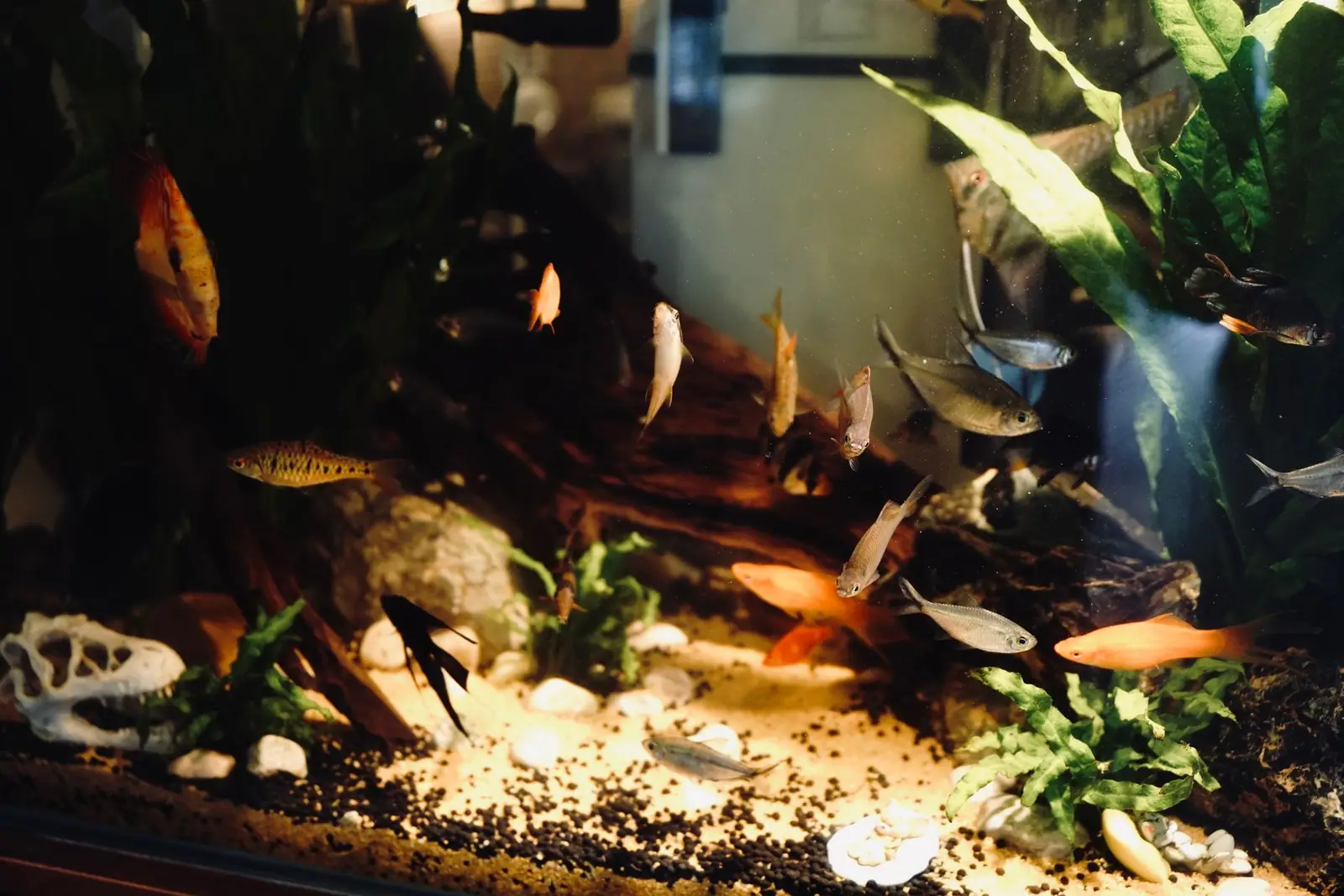
The electricity worksheet separates lighting from filtration. A lamp timer should not inadvertently switch off an essential filter that shares its power strip. Label connections and keep the control arrangement simple enough for a caretaker to follow.
At eight hours a day, a 22 W lamp costs $12.85 a year
Using a hypothetical eight-hour daily schedule and $0.20/kWh tariff, annual electricity is power divided by 1,000 times eight times 365. A 14 W fixture uses 40.88 kWh and costs $8.18. A 22 W fixture uses 64.24 kWh and costs $12.85. A 42 W fixture uses 122.64 kWh and costs $24.53.
These calculations assume constant rated draw during every lit hour. Dimming, sunrise modes and measured power can change the result. They also compare different fixture lengths, so the cheaper electricity number does not mean the shortest lamp serves a longer aquarium.
At a hypothetical 40-cent tariff, the same 22 W operation costs $25.70 annually. EIA’s July 2026 U.S. residential benchmark was 18.31 cents per kWh, but a household should use its own variable rate. Fixed utility fees do not disappear when the lamp consumes less.
Energy savings alone can produce a long payback
For a replacement example, assume an existing fixture draws 40 W and a suitable new fixture draws 22 W for the same eight hours daily. The 18 W difference saves 52.56 kWh annually, worth $10.51 at the assumed 20-cent rate. The old wattage and runtime are assumptions; the calculation is not a tested comparison between named fixtures.
If the $48.99 purchase were made solely to obtain that saving, simple payback would be about 4.7 years, using the unrounded saving. Adding a hypothetical $10 delivery charge increases it to about 5.6 years. An old lamp that has failed changes the question: replacement may be necessary regardless of the payback against a working fixture.
Select the light and schedule for the inhabitants, follow the fixture’s water and electrical instructions, and ask an aquatic-care professional when those requirements are uncertain. Reducing care below the tank’s needs is not an energy saving to credit to the purchase.
Keep the invoice, adapter model and warranty conditions with the setup records. A stated LED lifetime is not necessarily a warranty on the entire driver, controls or brackets. The aquarium care budget should show the new purchase once and electricity as recurring consumption, with future replacement spending added when it is needed.
Questions people ask
Is a $10 aquarium light listing a whole fixture?
Not on the HG978 page checked here. The $10 option is a pair of brackets. The smallest complete fixture lists at $29.99, so select the product variant before comparing prices.
How much does the 24–30-inch HG978 cost?
Its 22 W version lists at $48.99 before checkout charges in October 2026. Verify current availability, the included supply and the fit across your tank.
Do LEDs pay for themselves quickly?
It depends on the old wattage, runtime, tariff and purchase cost. The example reduction from 40 W to 22 W saves $10.51 yearly at eight hours daily and $0.20/kWh; that may give a multiyear payback.
Does a 24-hour mode mean full brightness all day?
No. Such programs can vary light through the day. Use the model's documented cycle and measured consumption, and select the routine for the tank rather than equating the mode name with continuous full-power operation.
Where these figures come from
- HG978 LED Fish Tank Lights: Prices and Controls Hygger · hygger-online.com
- Plant Spectrum Bluetooth LED Specifications Fluval · fluvalaquatics.com
- Aquarium Lighting Questions Aqueon · aqueon.com
- Electric Power Monthly: Table 5.6.A U.S. Energy Information Administration · eia.gov
Figures last checked October 2026.