On this page
A movable coop is worth considering when the yard has several reachable, secure places to put it and someone can carry out the moves. Wheels can make the physical task easier, but they do not create extra land or remove the need to check the enclosure after each relocation.
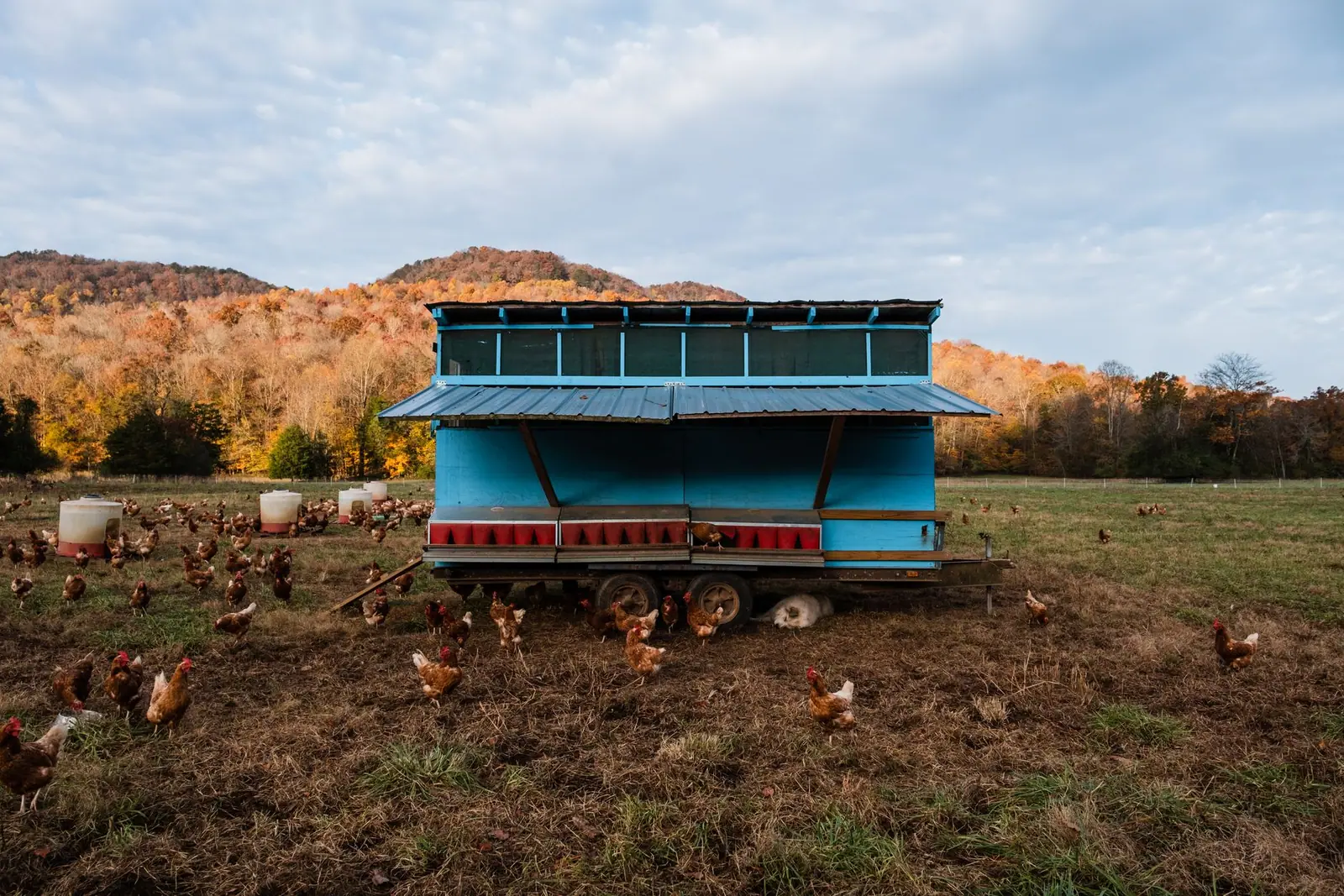
The published package comparison below comes from Omlet’s U.S. listing checked in October 2026. It distinguishes housing, attached run length and wheel options. The large mobile shelter in the cover photograph is an illustration of wheeled housing, rather than the smaller Omlet model priced in the table.
Key figures
- $1,099 Omlet Eglu Go UP, six-foot run, no wheels
- $1,199 Omlet Eglu Go UP, six-foot run, with wheels
- $160 Separate Omlet Eglu Go UP wheel set
Wheels add $100 to the named run packages
The Go UP has several configurations, so a starting price without a run should not be compared with a package including one. At the check, the six-foot run package in purple and the wheel-equipped six-foot packages were listed in stock; some other colors and house-only variants were unavailable.
| Named Go UP configuration | Listed price | Wheel comparison |
|---|---|---|
| Coop with 6-foot run | $1,099 | No wheel set in the named package |
| Coop with 6-foot run and wheels | $1,199 | $100 more |
| Coop with 9-foot run | $1,249 | No wheel set in the named package |
| Coop with 9-foot run and wheels | $1,349 | $100 more |
| Separate Go UP wheel set | $160 | Add-on for a compatible Go UP |
Source note: Omlet U.S. product and wheel-set listings, checked in October 2026. Package names distinguish included run length and wheels. Color availability can differ; taxes, optional accessories and paid assembly are not included in this comparison.
- Coop with 6-foot run$1,099
- Coop with 6-foot run and wheels$1,199
- Coop with 9-foot run$1,249
- Coop with 9-foot run and wheels$1,349
Source note: Omlet U.S. product and wheel-set listings, checked in October 2026. Package names distinguish included run length and wheels. Color availability can differ; taxes, optional accessories and paid assembly are not included in this comparison.
If the six-foot run package and separate wheel set were bought at those prices, the combined subtotal would be $1,259. The equivalent wheel package is $60 less. That arithmetic matters for a new purchase; a household already owning the compatible coop would compare the $160 retrofit with its other options instead.
The nine-foot run package adds $150 relative to the six-foot configuration whether or not wheels are included. A longer run can change moving effort and the clear area needed. Do not treat the $150 difference as a square-foot price without checking the whole enclosure’s dimensions.
The yard determines whether movement is practical
Map the route between the intended positions before ordering. Gates, steps, soft soil, slopes and narrow passages can make a wheeled coop difficult to relocate. A design that moves easily on a flat lawn may still need help on the household’s ground.
For a layout exercise, suppose each position needs an unobstructed eight-by-twelve-foot working area. That is 96 square feet. Four nonoverlapping positions would require 384 square feet before paths or extra access. These assumed dimensions are not the manufacturer’s footprint and do not establish a pasture-recovery schedule.
If only one suitable location exists, the wheels may help cleaning or temporary access rather than routine rotation. Price that benefit honestly. A portable design sitting in the same muddy spot all year does not supply the fresh-ground advantage used to justify buying it.
Use the free-range versus enclosed-run guide to consider outdoor access. Moving an enclosure and releasing birds to range freely are different management choices, with different boundaries and supervision questions.
The house’s capacity stays the same after adding wheels
Omlet describes the Go UP house for up to four small-to-medium chickens or two to three larger breeds. That is its product description, not a universal stocking rule for all birds or all periods of confinement. Adding wheels does not make the sleeping area larger.
Penn State’s small-flock guidance gives two square feet of indoor coop space per bird. Under that guideline, four birds imply eight square feet and six imply twelve. Compare the measured usable housing area and the flock’s size with the coop-space guide rather than using the word “portable” as a capacity specification.
Outdoor run area, weather protection and room to move are separate from the sleeping-house figure. A product’s maximum house occupancy should not be presented as evidence that every attached run supports continuous confinement at that count.
Assembly and ground preparation change the delivered budget
For a hypothetical first-year equipment worksheet, start with the $1,199 six-foot-run wheel package. Add an assumed $100 assembly charge, $50 for ground preparation and $40 for a compatible cover. The result is $1,389 before any other charges.
Only the package price is published here. The added numbers are example inputs, and compatibility, local labor and the needed cover determine their replacements. A quote that bundles assembly and delivery should not have those same charges added again.
If the household already owns a stationary coop, buying a second structure creates a different comparison from choosing between two new designs. Include the cost of keeping, adapting or disposing of the existing housing. A $100 wheel premium within a new package is not the total cash cost of abandoning a working coop.
The build-or-buy coop comparison helps keep structure, run and site work visible. A low-priced house without a protected run can require more additions than a higher-priced package that already includes one.
Moving time and protection determine the ongoing value
A hypothetical five-minute move each week adds up to 260 minutes, or about 4.3 hours, over 52 weeks. Moving every day at that same assumed time uses 1,825 minutes, or about 30.4 hours. Include the route, feeders, drinkers and post-move checks when timing the task; lifting the handle is only part of the work.
Household time can influence the choice without becoming a paid saving. If wheels shorten an assumed ten-minute move to five minutes weekly, the annual difference is about 4.3 hours. It is not a reduction in a contractor bill unless someone was being paid for those moves and the charge changes.
Check the boundary every time the coop is repositioned. Ground gaps, uneven skirts, catches and nearby obstacles can change predator protection. The predator-proofing guide covers those separate considerations; wheeled housing should not be described as predator-proof merely because it can move.
Follow the coop’s moving and anchoring instructions, preserve ventilation and weather protection, and confirm that all birds and equipment are secure after relocation. Neither wheels nor fresh ground replace routine care or biosecurity.
USDA APHIS emphasizes reducing disease exposure through people, equipment, feed and water. A movable coop can still meet contaminated wild-bird material or carry contaminated tools between areas. Make the decision from the usable yard, care routine and full purchase scope, rather than promising that rotation alone prevents illness or feed costs.
Questions people ask
How much extra do wheels cost in the named package?
The six-foot Go UP run package lists $1,099 without wheels and $1,199 with them. The separate compatible wheel set is $160, making the combined separate purchase $60 more at those prices.
Does a movable coop hold more chickens?
No. Wheels change mobility rather than house area. Omlet describes the Go UP for up to four small-to-medium birds or two to three larger ones; assess space and confinement conditions separately.
How much yard space does rotation require?
Measure the product and the route. The article's four 96-square-foot positions total 384 square feet only as a layout exercise, not a universal footprint or pasture-rest prescription.
Will wheels save money each year?
They can reduce moving effort, but that is household time unless a paid bill changes. Do not assume savings in feed, repairs or disease costs from mobility alone.
Where these figures come from
- Eglu Go UP: Run Packages, Wheels and Capacity Omlet · omlet.us
- Go UP Wheel Set: Separate Price Omlet · omlet.us
- Successfully Raising a Small Flock: Indoor Space Penn State Extension · extension.psu.edu
- Defend the Flock: Exposure and Biosecurity USDA APHIS · aphis.usda.gov
Figures last checked October 2026.